
News
Power Cable Resistance
Power Cable Resistance
At home, my radio station is all crammed in a very tight space so the main battery bank is in a detached container about 55 ft away. A few weeks ago, I purchased a N8XJK Super Booster to keep the voltage at the radio constant when the battery voltage drops too low. So far, I’m very happy with it. The main advantage for me is that the booster helps get around the voltage drop in the 55 ft long cable between the battery bank and radios during transmit. Here’s a schematic of my setup:
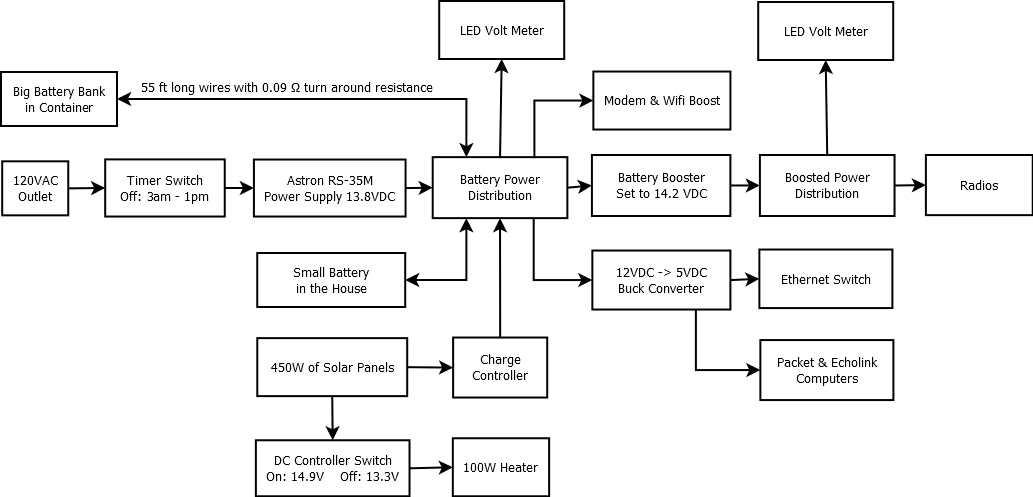
To quantify the voltage drop, I recorded the current draw, the voltage at the house, and the voltage at the container during six short transmissions at different power levels:
| Current (A) | House Voltage | Container Voltage | |
|---|---|---|---|
| No Tx | 8.2 | 12.9 | 13.3 |
| 5W | 11.4 | 12.3 | 13.2 |
| 12W | 13.5 | 12.1 | 13.2 |
| 25W | 14.0 | 11.9 | 13.1 |
| 50W | 16.7 | 11.6 | 13.1 |
| 100W | 21.0 | 11.1 | 13.0 |
| >100W | 28.7 | 10.5 | 12.9 |
The first line (8.2 A) is the baseline when the radio was not transmitting (I have two computers running, an ethernet switch, and two radios monitoring). Notice how at high power, the voltage available at the house is much lower than the voltage available in the container. The voltage drop is in the cable between the two.
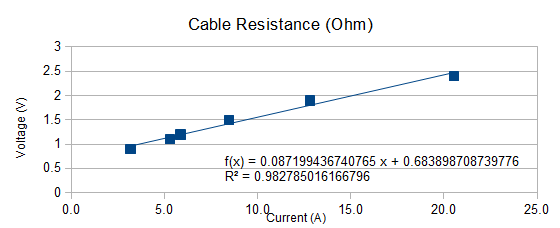
Taking the difference between the currents during transmit and the baseline current of 8.2A, and the difference between the container voltage and the house voltage, I get the voltage drop in the cable as a function of the current:
| Current (A) | Voltage Drop (V) | Power Loss (W) | |
|---|---|---|---|
| 5W | 3.2 | 0.9 | 2.9 |
| 12W | 5.3 | 1.1 | 5.8 |
| 25W | 5.9 | 1.2 | 7.0 |
| 50W | 8.5 | 1.5 | 13 |
| 100W | 12.8 | 1.9 | 24 |
| >100W | 20.5 | 2.4 | 49 |
The slope of the line is the resistance since: , which in my case is 0.09 Ω. Note also how much power is loss in the cable. The booster helps maintain a constant 14V at the radio, but the total power used can be much higher because of the loss in the line.
A trick to help reduce this power loss is to add a smaller battery in the house. The idea is that during transmit, some of the current will be drawn from that smaller battery. Since less current will flow through the longer cable and the voltage drop will be reduced, the power loss will also be reduced. Here’s the same table again when the small battery is connected:
| Current (A) | Voltage Drop (V) | Power Loss (W) | |
|---|---|---|---|
| 5W | 2.8 | 0.5 | 1.4 |
| 12W | 4.8 | 0.6 | 2.9 |
| 25W | 5.2 | 0.6 | 3.1 |
| 50W | 7.3 | 0.6 | 4.4 |
| 100W | 10.8 | 0.7 | 7.5 |
| >100W | 16.7 | 0.8 | 13 |